
***I recently found a blog post that I must have worked on while I was in China, but never finished and published! I publish it now for your reading pleasure!***
One of my favorite parts of living in this beautiful country is the language. Mandarin is so different from every language I had exposure to before 2017; it’s a constant source of curiosity and opportunities for learning.
In fact, when I first started studying Mandarin, I wondered if perhaps I would want to eventually spend time teaching it as a foreign language. (If I’m ever in Goshen and the college needs a short-course Mandarin instructor…). Before leaving for China, I took as many opportunities as I could find to study with (and sometimes tutor) my Study-Service Term classmates, and I eagerly devoured articles, blogs, and videos about how people approach learning Mandarin and strategies for doing so.
I have often said that Mandarin is not so much a difficult language as it is a “big” language. I don’t think the difficulty people experience studying Mandarin comes primarily from its complexity, but rather from its immensity. I will use the character 石 as an example. You see, every word in Chinese has many parts:
- Character(s). Every word has a character (or characters) that represent its written form. You could also say this is the “true” form of the word, as it is the word’s unique identifier. Because I am using writing to tell you about this, you have already seen the character for 石 — it’s 石!
- Stroke Order. In order to correctly write a character, you need to know the order of the strokes. If you write 石 with the little box-looking part (口) first, you haven’t written it correctly. If you write the box last, but you start with the bottom part of the box first, you’re still wrong. There are patterns to the strokes, so it’s not just rote memorization, and the patterns work their way into your muscle memory the more characters that you learn and the more that you write. Still, this is an additional, separate piece of information that you need to learn for each word when you are beginning to learn the language.
Here is the proper stroke order for 石: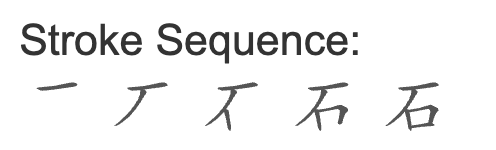
- Components. These are sometimes also called radicals, and they are characters that can be combined to form new characters. For example, 口 in 石 is actually its own character with its own meaning and pronunciation! I’ll leave a detailed explanation of this system (it’s really cool) for a possible future post.
- Stroke Order. In order to correctly write a character, you need to know the order of the strokes. If you write 石 with the little box-looking part (口) first, you haven’t written it correctly. If you write the box last, but you start with the bottom part of the box first, you’re still wrong. There are patterns to the strokes, so it’s not just rote memorization, and the patterns work their way into your muscle memory the more characters that you learn and the more that you write. Still, this is an additional, separate piece of information that you need to learn for each word when you are beginning to learn the language.
- Meaning. Of course, the meaning of the word is essential if you seek to communicate. Understanding the meaning (or translation into your native language, when you start) is key. The most basic meaning of 石 is stone or rock. (It’s also a surname!)
- Pronunciation. A word is nigh-useless if you don’t know how to say it! In Chinese, however, the pronunciation is separate from the written form of the word. (This is actually less true than that sentence makes it seem, but I digress). Today, we most commonly use a romanization system called Pinyin (拼音) to transcribe pronunciation into the latin alphabet. The pronunciation of 石 is written shi, and sounds almost like the English word “sure” (when pronounced as “sher” and not “shore”).
- Tone. There are four primary tones and a neutral tone in Chinese. This is what makes the language sound (in my opinion) musical and what gives it its distinctive sound. These are represented in writing with four patterns written above key vowels:

The tone for 石 (shi) is second tone, which is a rising tone. The pinyin would be written shí to show this. We often use a rising tone in English when we ask a question, as in “are you sure?”
(The fact that a “2nd tone” marking is exactly the same as an accent in Spanish did not fail to utterly confuse me when I took a Spanish class the semester after returning from China. Every time I see, for example, café, I instinctively make use a rising tone.)
This illustrates one of the most fundamental differences between Mandarin and English: in English, we use tones across phrases, and the same phrase can have a different meaning when said with a different tone. We also put emphasis on certain words to distinguish meanings (imagine emphasizing each of the four words in the sentence “is / that / her / bottle?”). In Mandarin, words carry tones on their own, and the same pronunciation can have a different meaning (be a different word) when said with a different tone. Emphasis is often expressed through sentence structure, word choice, and the use of particles (words that don’t have their own meaning but change the overall meaning of a sentence or phrase).
- Tone. There are four primary tones and a neutral tone in Chinese. This is what makes the language sound (in my opinion) musical and what gives it its distinctive sound. These are represented in writing with four patterns written above key vowels:
- Measure word. This is a fascinating one. If the word is a noun, then it has a companion word that acts as a quantifier. This concept exists in English but is limited to only some nouns. Basically, any time that you have to add a word between an indefinite article (“a”) or a number (“one”) and a noun, you are using a measure word.
Some great examples in English are uncountable nouns or groups of animals. Think of grass: “one ____ of grass.” You could have a field of grass, a blade of grass, a pile of grass… but you can’t have “a grass.” Grass is an uncountable noun. There are many more — can you think of any?
One tricky thing in English is that we have some nouns that use measure words but are also kind of countable. For example, you could have “a bar of chocolate,” or “a piece of chocolate,” but sometimes we also say “give me a chocolate.” No measure word necessary.
As for animals, think of all those cool words you learned for groups of animals: “a murder of crows,” “a clutch of chicks,” “a litter of puppies.” You can’t say “a crows;” you need to specify a what of crows, even though there is often only one possible word that could go in that blank. (Why don’t we just use “a group of” for everything?!)
These examples may help to point out the necessity of these words: without them, unless you have sufficient context, it is very easy to misunderstand what quantity a person is referring to. Imagine if someone asked for “two pizzas” when ordering lunch, only to be dismayed when they learn that they have ordered 16 slices and are out $30 when all they wanted was two slices of pizza.
All this is to say: in Chinese, these words are necessary and cannot be left out, and many nouns have a specific measure word that must be used. Though there are patterns and reasons for which measure words go with which nouns, it is still one more piece of information that you need to know when learning a new word — does this word have a specific measure word, and if so, what is it? (And of course now you need to learn to recognize and pronounce and write that word as well).
The best measure word for “a rock” would be 块; “one rock” is then “一块石.” (I’m oversimplifying; properly, it should be “一块石头,” because 石 by itself is a character but not a complete word. Like I said earlier, characters and words are not equivalent).
So this is why I say Chinese is “big” rather than “hard.” Learning a new word in Chinese takes significantly more effort than learning a new word in Spanish; besides the potential overlap with English that Spanish has, Chinese words simply have more pieces to them that have to be learned separately. You need to learn the character, the stroke order, the meaning, the pronunciation, the tone, the measure word… and these are all mostly separate from each other and cannot be derived from each other. It’s only once you’ve learned a few hundred words that you begin to see and understand the patterns that make these separate pieces start to blend into the background.
I think it’s important to recognize this because many other parts of Chinese are not actually particularly complicated. Much of Chinese grammar is relatively simple and straightforward, and there are few exceptions to rules. There are no conjugations to speak of. Words don’t have gender, and adjectives never change for gender or number. Question structure is very intuitive, not requiring rearranging like in English. Many vocabulary words are sensible compounds of simpler words (example: 手机 / shǒujī combines the characters for “hand” and “machine” but translates as “(cell) phone”).
So, there you have it! Don’t be afraid of learning Mandarin because you’ve heard “it’s so hard” — rather, be excited, because it is fundamentally different from English (and other Germanic languages, Romance languages, etc)! There are so many cool pieces to Mandarin!
Studying another language always exposes you to different ways of thinking, news ways of explaining concepts, unknown linguistic or grammatical patterns. Most people don’t learn the names for tenses (simple tense, perfect tense, etc) or even what a “conjugation” is until they study another language. When that language is more distant from your native language, all of these learnings are compounded! It becomes an opportunity, not a chore.
And if you ever want to talk about Chinese when I’m around… just ask!
(This is the part where I put my affiliate link to Duolingo…
Just kidding!)
Discover more from China and Beyond
Subscribe to get the latest posts sent to your email.
Christian, Very interesting. Since I have never learned any language but English, this was enlightening. Frank
>