
This post is part of a series. The previous post was Join The Great “Can Jam” of 2026! This post is co-written with my brother Andrew, whose contributions appear behind-the-scenes and in green.
Light bulbs are amazing. The idea that we can turn electrical energy into visible light — and that we now do this billions of times a day — is simply incredible, and honestly mind-boggling once you begin to think about it.
(I have a whole post coming about how electricity is literally magic, but we’ll save that discussion for later).
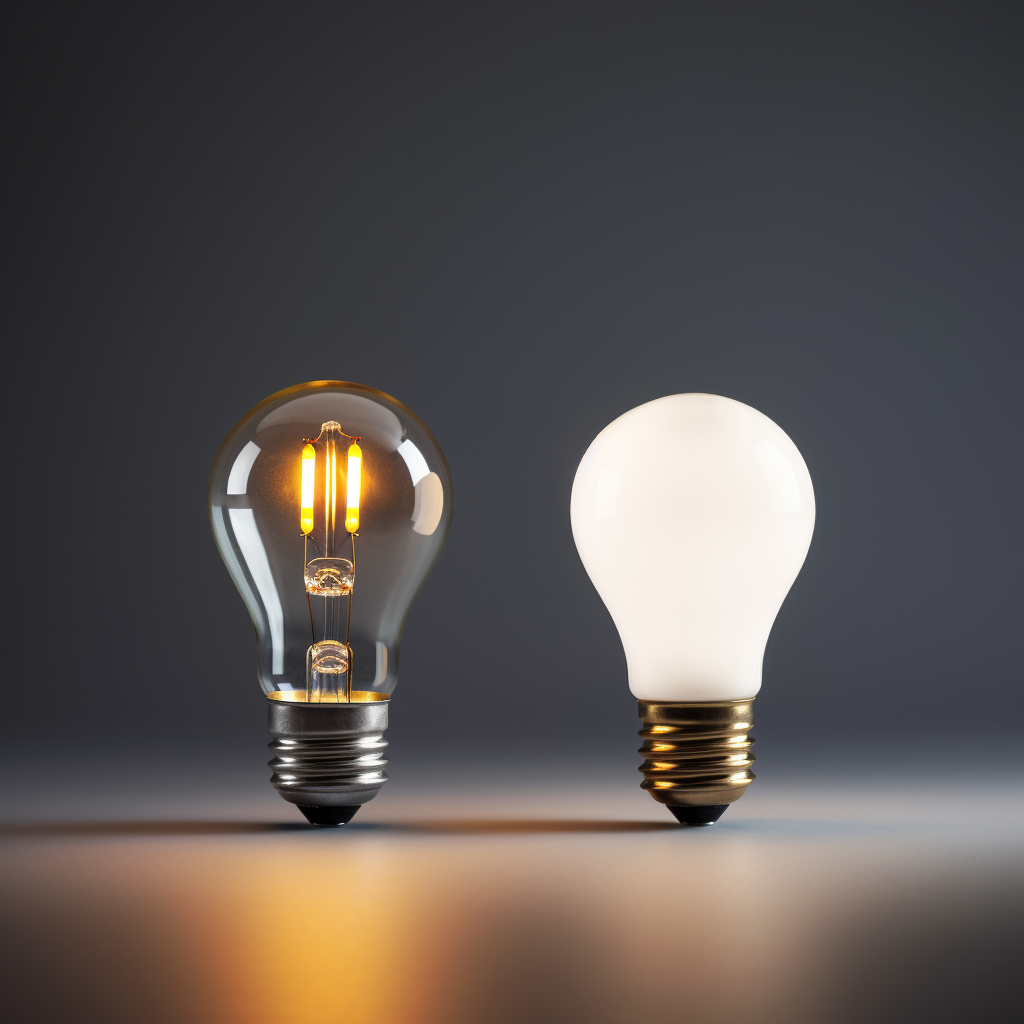
However, not all light bulbs are created equally. Some light bulbs are simply better than others.1 We are here today to convince you that you should literally THROW AWAY any incandescent bulbs you have sitting around (or lighting your abode). Yes, we know throwing things away is Bad with a capital B. We don’t usually encourage it. But the math will make our case for us.2
First, though, we need to understand a bit about light bulbs. For a quick primer, feel free to watch this video alongside our discussion below.
Incandescent bulbs essentially work by heating a small amount of metal up until it starts to emit visible light. That’s right, the game plan is literally just “let’s make this hot, and then it’ll glow!”
Now, don’t get us wrong: all kinds of impressive engineering and design went into these light bulbs. They are far superior to lighting fuels on fire (like the gas lamps they replaced). There are all kinds of technical questions behind improving this process (what kind of metal should we use? how can we stop the metal from falling apart when it gets so hot?) that resulted in a number of technical innovations that are quite astounding (settling on tungsten filaments, creating a vacuum inside the bulb, mass-production, and more).
The problem is, creating light by heating something until it glows is terribly inefficient. Imagine if you needed some light in your kitchen, so you turned on your stovetop burner until it glowed red-hot so that you could see. Hopefully we would agree that that’s a pretty dumb way to go about it (no offense to hypothetical you). Incandescent bulbs are basically a (albeit much more refined) version of this practice.
So it’s no surprise that these incandescent bulbs became the norm. But it’s also no surprise that now, 150 years after they were invented, they are out of date.
There have been plenty of other developments in the science of lighting. Many of them are mentioned in the video linked above. However, we’re here to simply compare the best commercial household option today, the LED bulb, with that old incandescent bulb you’ve got lighting up your living room.
Because incandescents, need I remind you, just use electricity to heat metal until it gets hot enough to get bright, they produce an enormous amount of waste heat. Most of the energy they use is released as heat, not as light. This has two major downsides: (1) they use a lot of energy for how much light they produce, and (2) all the heat they release simply goes into your home, which is not always a good thing.
LED bulbs are much more efficient. We’re talking about 7 times more efficient — that’s nearing an order of magnitude. A 60W light bulb can be replaced with a 9W LED bulb, and a 40W incandescent bulb can be replaced with a 6W LED bulb.
LEDs have another advantage: they are generally manufactured to last for 10000+ hours,3 much longer than the 1000 hours that incandescent bulbs typically last.4
But I want to return to the efficiency advantage. As far as I know, there is NO other comparable jump in efficiency in a household product, ever, and there never will be. Can you imagine if someone came out with a car that got 300 miles to the gallon? (Electric cars are more efficient than gas cars, but not nearly that much more efficient). Can you imagine if someone made a smartphone or laptop battery that lasted 2 weeks rather than the 2 days that today’s best phones can manage? That’s the kind of jump in efficiency we’re talking about here.
If you read our last post, you know we like to keep track of the amount of energy saved by different methods. Recycling an aluminum can saves 250 Wh (.250 kWh) compared to making a new one from scratch. Based on our calculations, replacing an incandescent bulb will save about 50 kWh over the course of its life — that’s the equivalent of recycling 200 aluminum cans, or driving my electric car 200 miles. One light bulb! 200 miles!
And, unlike recycling aluminum cans, this is all electricity that you would have been paying for. That means, at a modest $0.15/kWh (your prices may vary), replacing a new incandescent bulb with an LED will save you at least $7.50 — much more than the LED itself costs.
Now, there are some caveats. Your incandescent bulb is not brand new, and those calculations were made assuming a full 1000 hours of use. Your bulb might have already used half its lifetime, so the savings might be half what we listed above. But you also might have 10 incandescent bulbs in your household right now, so you could easily save yourself $30 or more (and a bunch of energy) by simply looking around to check. (As an aside, this is what Andrew did the last time he visited me — he walked in, greeted us, then said “ooh, is that an incandescent?? Let me swap it out!” and proceeded to do a bulb-hunt through our entire house).
We’ll finish up with a couple FAQs here.
What should I do with this incandescent that I just replaced with a much better bulb that’s going to save me money and reduce my energy consumption?
Unfortunately, there isn’t really a good option besides throwing it away. Even though these bulbs are mostly made of glass and metal, the way they are formed makes them difficult and not cost-effective to recycle (unlike aluminum cans), and most municipal recycling programs don’t accept them. You may be sad not to get use out of the bulb while it is still functioning, but consider this: it is going to get thrown out anyway. The unfortunate reality is that these bulbs are simply disposable items and are going to end up in a landfill eventually. That was true when you bought it and it will be true at the end of the bulb’s lifespan regardless. The only choice you have now is whether you’re going to use an extra 50 kWh and $7+ of electricity — most of which will be wasted as heat — or save money and energy by choosing not to use it. Honestly, this is the hardest part of this experiment, and it’s still hard for me to throw away incandescent bulbs. But the math says it’s the better choice to make.
As always, if you can come up with a creative way to reuse this bulb in some sort of artistic project, that is great. But don’t reuse it by actually using it for light — that would defeat the purpose!
What about other bulb types?
We reserve this process for incandescent bulbs only. We don’t recommend replacing your still-functional CFL bulbs with LEDs (CFLs are the curly, individual-tube bulbs) — CFLs are only about 50% less efficient than LEDs, compared to the incandescent’s 700%, so they’re still relatively close in lifetime power consumption. But you should definitely choose to buy LEDs rather than CFLs when you get a choice. CFLs are not only less efficient, but they also contain mercury, which makes them complicated to dispose of. They need to be taken to special recycling facilities, or they risk leaking mercury into landfills and waterways. Please dispose of your used bulbs properly!
The reason we’re writing this post is that incandescent bulbs (and, it seems, CFLs) are now relics of the past: we’re never going to go back to them as a society. In fact, the US banned the production and sale of incandescent bulbs in 2023. That means pretty much the only incandescents that are left are the ones in your house right now. Collectively, they are wasting massive amounts of electricity and money (and producing needless heat during the hottest years on record) across the country. We should have done this years ago!
How do I know if a bulb is an incandescent?
If you live near us, Andrew and I will gladly (1) come to your house and tell you if you have incandescent bulbs and (2) give you free LED replacements. That’s how committed we are to this idea.
CFLs have a funny swirl shape and are easy to tell by sight. The easiest way to tell if a bulb is an incandescent is to touch it after it’s been on for a while — it will be hot, whereas an LED will stay cool (some LEDs get warm to the touch, but never painfully hot as incandescents will). You can often see the glowing filament inside an incandescent bulb (especially right after you turn it off). Incandescent manufacturing got sneaky towards the end of being legal in the US, and many incandescents have frosted glass so they appear more like LEDs. They also got better at making incandescents last longer towards the end of their production, which is actually a curse in disguise. Many incandescents still around today are “long life” bulbs that last 2,000 or 2,500 hours, much longer than the standard 1,000 hours. Finally, the base or glass of the bulb will have power information, and LEDs will be in the 5-15W range whereas incandescents will be in the 40-80W range. (LEDs might say “60W equivalent” but will then say 9W elsewhere. This just means they produce as much light as a 60W incandescent. Don’t think it’s an inefficient bulb just because you see the number 60!).
This is a neat idea! What else can I do?
- Offer to replace bulbs in other peoples’ homes! Or tell them to check out this post and do it themselves! Spread the word!
- Buy incandescent bulbs at thrift stores (then throw them away) so that others don’t buy them.
- Become a ninja and replace incandescent bulbs in public areas (bathrooms etc) with LEDs. This is not recommended, but it is an option. Similar to dumpster diving or pulling aluminum cans out of other peoples’ trash cans to recycle them, it may be a good sort of trouble, but it could still get you in trouble!
- Subscribe to the blog: more sustainability posts coming your way!
- One could even say “all light bulbs are equal (i.e. create light), but some are more equal than others.” ↩︎
- It’s important to note that, as we will see, this is only our advice due to the magnitude of the efficiency difference. You should NOT throw away perfectly useful items chasing a 10% efficiency gain. That isn’t financially or environmentally sustainable. A 700% efficiency gain is a different story, however, and we lay out that reasoning in the rest of the post. ↩︎
- 10000 hours is a conservative estimate. Many estimates place them at 15000-50000 hours. ↩︎
- There’s a low-grade conspiracy theory that incandescent bulbs were intentionally designed to last for less than their optimal lifespan (1000 hours instead of 5000+ hours) as a form of planned obsolescence. As is often the case, it’s more complicated than that. It turns out that incandescent bulbs have to balance efficiency, lifespan, quality of light produced, and other factors. LED bulbs have fewer restrictions. Check out this (rather long but interesting) video for more on that topic and light bulbs in general. ↩︎
The featured image for this post can be found here.

Christian, Leigha, and Andrew,
Thank you for shedding light on this subject. I was on the edge of my seat wondering if we were using the “right” light source. Whew! Happy to say we are an LED household.
On the other hand, part of my inheritance from my father is a bucket full of incandescent light bulbs. I have been wondering what to do with them. I hate to waste things so I haven’t thrown them out. Yet, I know they are inefficient so I don’t plan to use them. I just keep them in their bucket. Your most convincing argument was they are “going to get thrown out anyway.” Unless of course I can come up with an art project….