
My brother Andrew is into recycling.
Like, really into recycling. He starts recycling programs wherever he goes. Odds are that at any given time, his little Prius hatchback is chock full of cardboard or metal as he gathers it to take it to a recycling center. He has probably spent a good 10 hours a week on average working on recycling projects for the last few years of his life. He’s been known to strip copper wires while calling his family. I once sent him a picture simply asking if a specific item was recyclable, and he responded with (I kid you not) 17 minutes of voice recordings talking about recycling. Just check out this video he made, which was supposed to be about an epic hike but instead became part of his recycling propaganda evil masterplan. You see what I mean?
The best part of this kind of world-saving passion is: it’s infectious. I care way more about recycling because Andrew does, and now I ask him for pointers on the finer points of recycling know-how.
This year, Andrew and I created a fun little game. I want to tell you about it and explain some of the details, but really I want to invite you to join us.
You see, Andrew already had a habit of picking up every aluminum can he could find. (Again, see the video above). And I’ve done my fair share of picking up trash or recycling while out for walks.
But it turns out, there’s science behind it all! Let me explain:
Aluminum is a wonderful, naturally abundant metal. We use it to make all kinds of things, from bikes to cars to airplanes to foil to… aluminum cans.
Another great thing? Aluminum is infinitely recyclable. You just melt it down and make new stuff out of it. Now you don’t have to go mine more rock to break down to electrolyze to get pure aluminum: just take what you already made and reuse it!
So, Andrew did a little research, and learned that it takes WAY less energy to recycle an aluminum can’s worth of aluminum than to mine and process new aluminum. This is because the recycling process is very simple (and aluminum is easy to recycle), while the original separation process is incredibly energy-intensive.
Andrew here! I actually read a really awesome book that I would recommend to everyone called “Garbology: our dirty love affair with trash” and learned that our country only recycles about half our aluminum cans, throwing the extra 30 BILLION in the landfill every year, wasting about 1 BILLION dollars. That’s a lot of money! We throw away enough aluminum every 3 MONTHS to scrap and rebuild our entire commercial airline fleet! And recycling aluminum is extra important because it takes 20 TIMES more energy to source new aluminum than it does to recycle old aluminum. This is so colossally dumb that I couldn’t help but try to up and DO something about it.
Recycling an aluminum can saves around 250Wh of electricity.1 Now, you may not be used to measuring energy in Watt-hours. So let’s break down what you could do with ONE recycled aluminum can’s worth of energy:
- Recharge your phone from 0% to 100% 20 times
- Run a standard LED light bulb (~7W) for 35 hours
- Run a 40-inch LED TV (~50W) for 5 hours
- Or, my favorite: drive my electric car about 1 mile
Yup. Recycling a single 15 gram aluminum can save the same amount of electricity as moving my 5,000-pound car 1 mile. That’s crazy!! (Note: that list is “any of these,” not “all of these”).
In theory, we should eventually have a closed system: we should just reuse (recycle) all the aluminum we’ve mined and never mine any more. It saves money to reuse aluminum! Unfortunately, MOST aluminum cans end up in land fills, where they will just sit for hundreds of years (that’s centuries, folks).
Enter the Can Jam.2
Andrew and I now have a mission: to pick up all the aluminum cans we find (most of which are probably destined for a landfill) and ensure they get recycled. We record our findings in a Google Sheet, which also calculates the number of kWh (kilowatt hours) saved and translates that into electric-car miles. (Though it’s an ironic calculation, because it’s roughly 4 cans to a kWh and roughly 4 miles per kWh, so it ends up as just 1 can per mile).
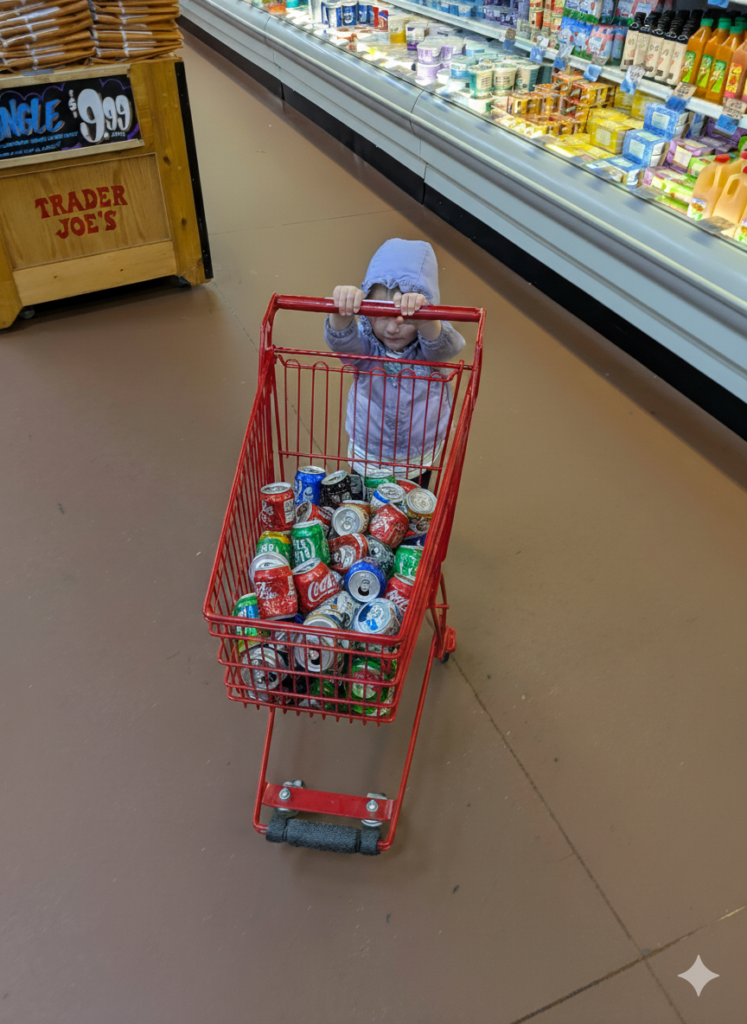
Our goal? To offset all the energy that my family uses in driving our electric car. (I’ll write a post about EVs soon). Unfortunately, in the last month or two since we started this project, we have fallen behind, and it will only get worse when Leigha and I move (and thus drive) all the way to Indiana this summer. (But we have saved over 500 cans from the landfill in just a month or so, so there’s plenty to do and it’s not very hard!)
Enter you! You (yes you) are formally invited to join us in our Can Jam experiment. The task? Simply pick up aluminum cans you find (you’ll be surprised how prevalent they are once you start looking), make sure they get recycled, and then record it in the Sheet. You may want to carry a bag with you. The only caveat: you are only allowed to count cans that you saved from getting landfilled. In other words, you don’t get to count cans that you buy and drink yourself; only record cans that you find on the side of the road (or in a public trash can, or under a bridge, or next to the train tracks…) that probably would have ended up in the trash but that you personally saved from annihilation. (Well, you prepared them for a different sort of annihilation — more reincarnation and less Gehenna3).
We would also love if you do the first two steps (pick up cans and make sure they get recycled) without keeping track of them or adding to our Sheet. Recording does provide a nice gamifying effect, but that’s certainly not the main point!
If you are interested in joining our gamified effort, though, simply send me an email (or leave a comment, or use the contact form on this site) and we’ll add you to our Google Sheet.
If you want to go the extra mile, you could also start recycling the aluminum cans thrown out by your coworkers/workplace (probably most of them). Just spread the word, set up a little bin with an “aluminum cans ONLY” sign, and come by regularly to pick them up.
If you want to be 100% sure the cans you collect will be recycled, you could save them up and take them to a local scrap yard (ask for the non-ferrous building) once you have 10 pounds or so, and even make a quick buck!
Let’s recycle some aluminum! 3 cheers for recycling! (For real, name something else that clearly helps both the economy and the environment, using big, modern, industrial factories).
- If you do your due diligence and actually click through to the article I linked, you will find that it calculates 210Wh, not 250Wh, which is a significant difference. However, its calculations are based on 12-ounce soda cans, and many of the cans that we recycle are significantly larger (often 16 or 24 oz). So we settled on 250Wh as a good approximation. Unfortunately, we are unable to get any more precise than a general average/approximation, but we do the best we can. ↩︎
- Please note that our Can Jam has no connection to Kan Jam®, a popular (and trademarked) yard game. ↩︎
- Gehenna is the Greek word most often translated as “hell” in the New Testament. It refers to the Valley of Ben-Hinnom, which was known in the Hebrew Bible/Old Testament as a place where kings sacrificed children by fire to other gods (see Jer 7:31). It is commonly said that by Jesus’ time it was a fiery trash heap outside Jersualem, hence my ironic reference to it above. However, it turns out there is no evidence for such a claim, so the joke doesn’t land as well as it could… ↩︎
Note: the featured image for this post was edited by / generated with Gemini AI, because I unfortunately could not find a fitting picture from our can-ventures.
Finally, you may enjoy this cool video on how aluminum cans are recycled! It’s amazing! The best quote is “manufacturing beverage cans IS rocket science.”
Discover more from China and Beyond
Subscribe to get the latest posts sent to your email.

When we lived in Ghana thirty years ago, we visited the aluminum (ahem *aluminium*) smelting plant in Tema where we learned that–at least back then–smelting required vast amounts of electricity. Electrical generation on the Volta River made the smelting plant possible.
Love the idea, love the video.